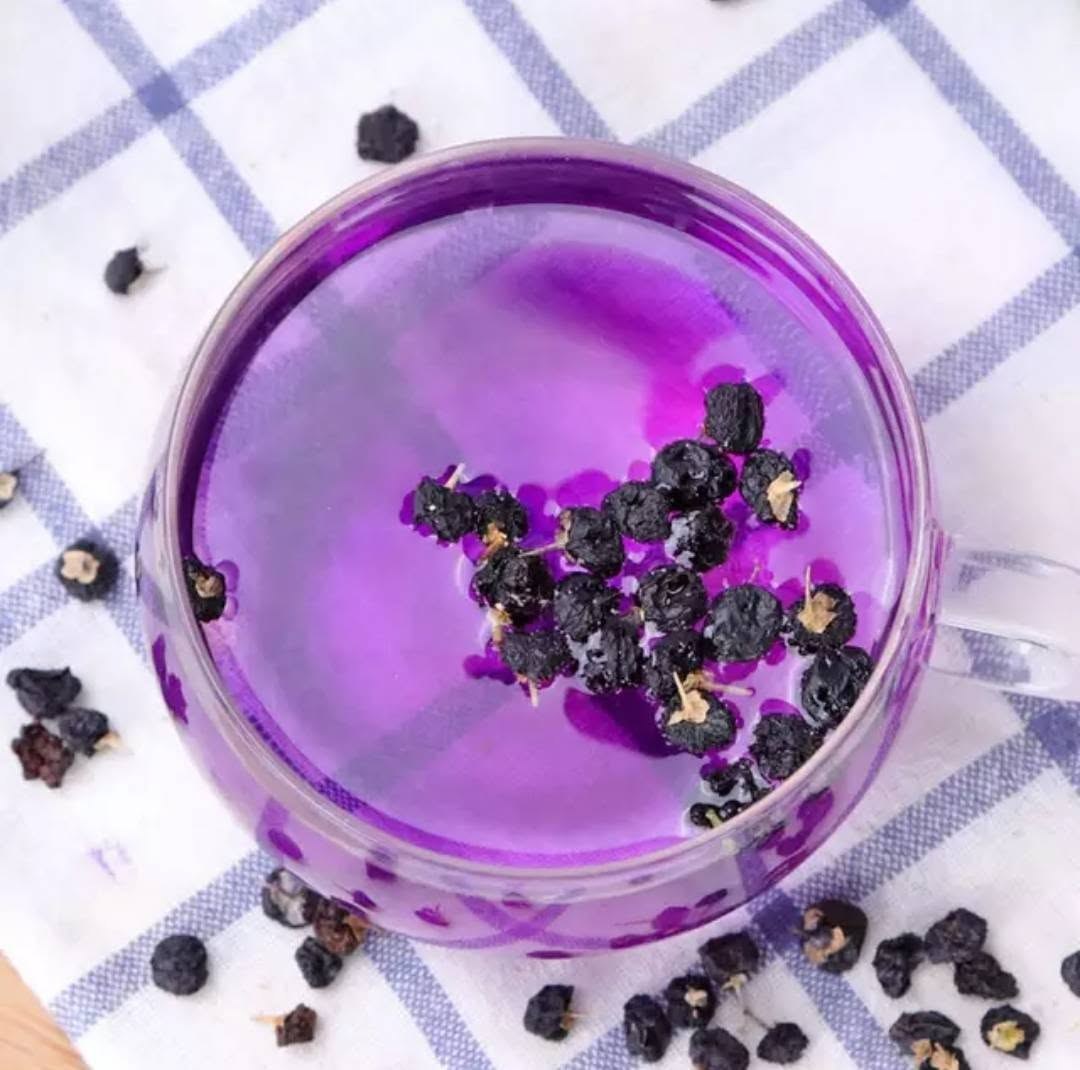
Black goji is a thorny desert shrub from Central Asia and Northwest China, a close relative of the familiar red goji. Its small purple-black berries are dried whole. Steeped in warm water, they turn the cup violet-blue, and a squeeze of lemon turns it pink. The taste is mild, lightly sweet and berry-like.
Scientific name
Lycium ruthenicum Murray
Family
Solanaceae (nightshade family)
Other names
Chinese 黑枸杞 (hei gouqi) and 黑果枸杞 (hei guo gouqi); black wolfberry; Russian box thorn
Origin
Central Asia to Northwest China, from Türkiye and the Caucasus to Mongolia. Today grown in Qinghai, Xinjiang and other parts of Northwest China
Flavour profile
Mild · lightly sweet · berry-like · violet-blue in the cup, pink with lemon
Black goji is a thorny, much-branched shrub of the nightshade family, Solanaceae, the family of tomatoes and potatoes. It usually grows 20–50 cm tall; old plants can reach 1.5–2 m. Its pale branches carry sharp spines and small tufts of narrow, fleshy leaves.
The funnel-shaped flowers are pale violet. They are followed by round berries, purple-black when ripe and 6–9 mm across, each with a few tiny seeds. The shrub flowers in early summer, and the berries ripen from late summer into autumn.
It is a plant of dry, salty ground: salt flats, sandy desert edges, riverbanks and roadsides, from the lowlands to over 3,000 m. It copes with drought and salt better than most shrubs, and on the grasslands where it grows it helps to hold the soil against wind and sand.
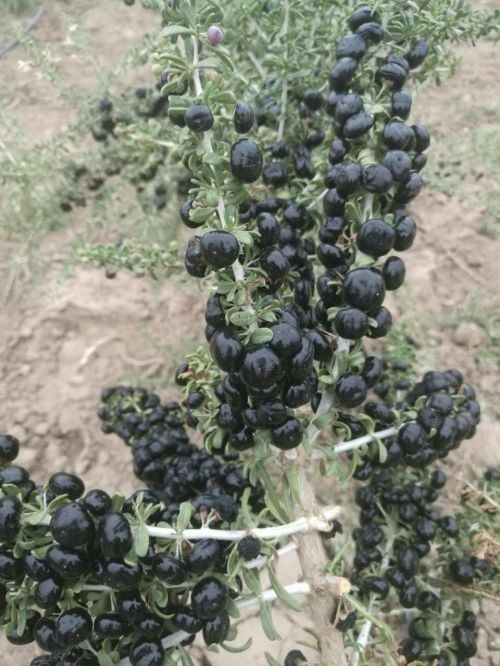
Ripe berries along the spiny branches
Black goji
Red goji
Latin name
Lycium ruthenicum
L. barbarum, L. chinense
Plant
Low, spiny desert shrub with fleshy leaves
Larger shrub with arching branches
Grown in
Qinghai, Xinjiang
Ningxia and other provinces
Colour from
Anthocyanins (purple)
Carotenoids (orange-red)
Usual use
Steeped as a tea
Eaten dried, in soups and teas
The story
A short history of black goji
Black goji grew on the dry lands of Central Asia long before it became a market crop. Its written story is short: a Tibetan book of medicines, a botanist’s name, and a recent rush for a colourful berry.
18th century
In a Tibetan book of medicines
The Crystal Pearl (Shel gong shel phreng), a Tibetan materia medica by Deumar Geshe Tenzin Phuntsok, records the berries among its medicines.
1780
A Russian name
Johan Andreas Murray, a botanist in Göttingen, names the plant Lycium ruthenicum, “Russian lycium”.
2015
A berry rush
Thousands of pickers crowd the grasslands around Golmud in Qinghai. In four years, the price of dried berries had risen from about 140 to nearly 500 yuan a kilo, and the authorities step in to protect the grassland.
2018
A natural colour
Food scientists describe the berries’ pigments as a promising natural colour, with vivid shades across a wide range of acidity.
2020
Graded by size
Qinghai drafts a food standard for dried black goji that sorts the berries by size: the larger the berry, the higher the grade.
Place and food culture
In China, black goji grows and is farmed in the high, dry basins of the north-west: in the Qaidam Basin of Qinghai, around Golmud and Nuomuhong at about 2,800–3,000 m, and in the deserts of southern Xinjiang. There the dried berries are drunk mostly as a tea, steeped in warm water, often in a clear glass so the colour can be watched as it spreads.
Further west, in Ladakh in the Indian Himalayas, the shrub grows along roadsides in the Nubra valley, where Amchi healers have used it in remedies and as a dye.
From berry to pouch
Picked by hand among the thorns
The berries ripen from late summer into autumn and are picked by hand from the spiny branches. Fresh, they are soft and spoil within about three days, so they are dried soon after picking. How they are dried decides much of the colour that later reaches your cup.
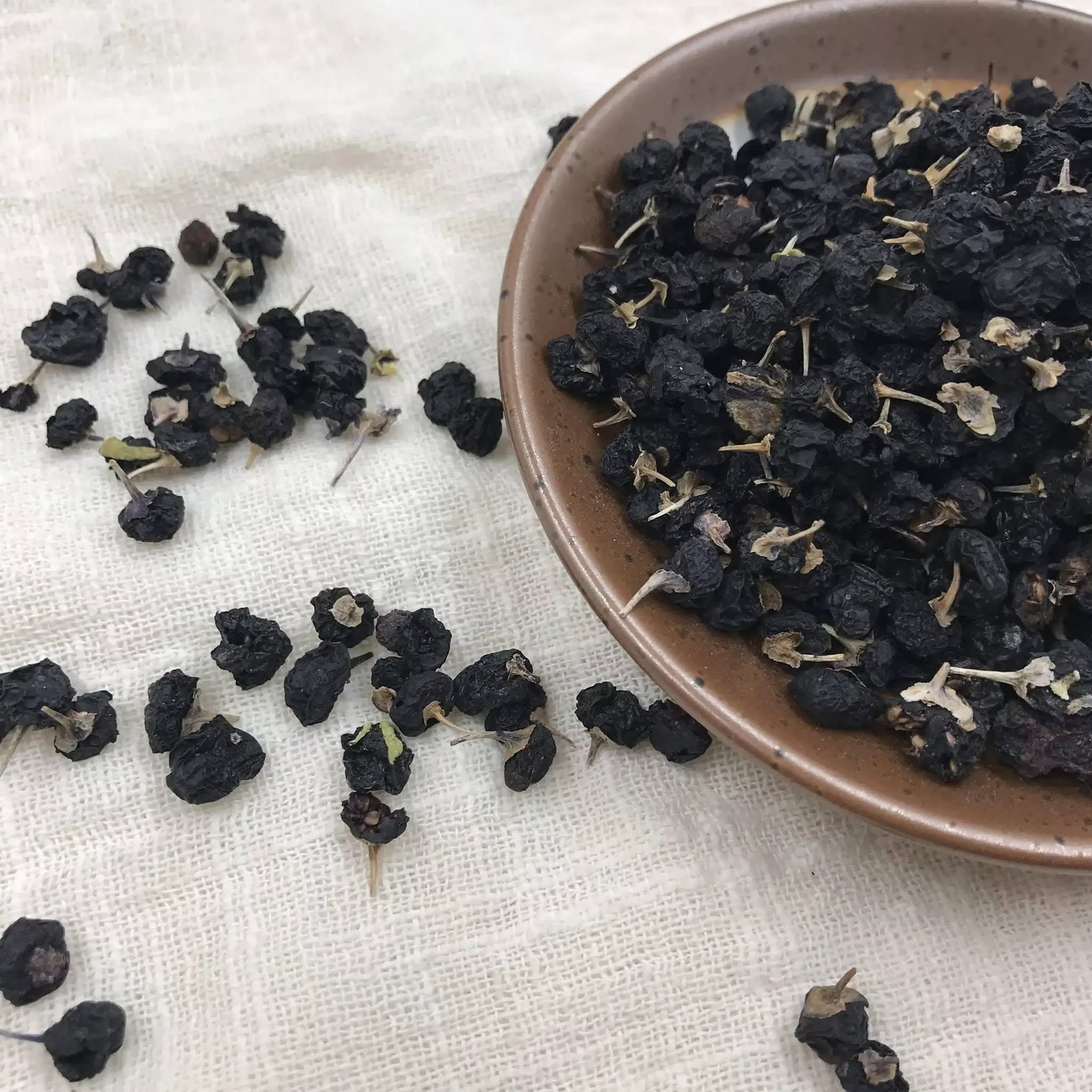
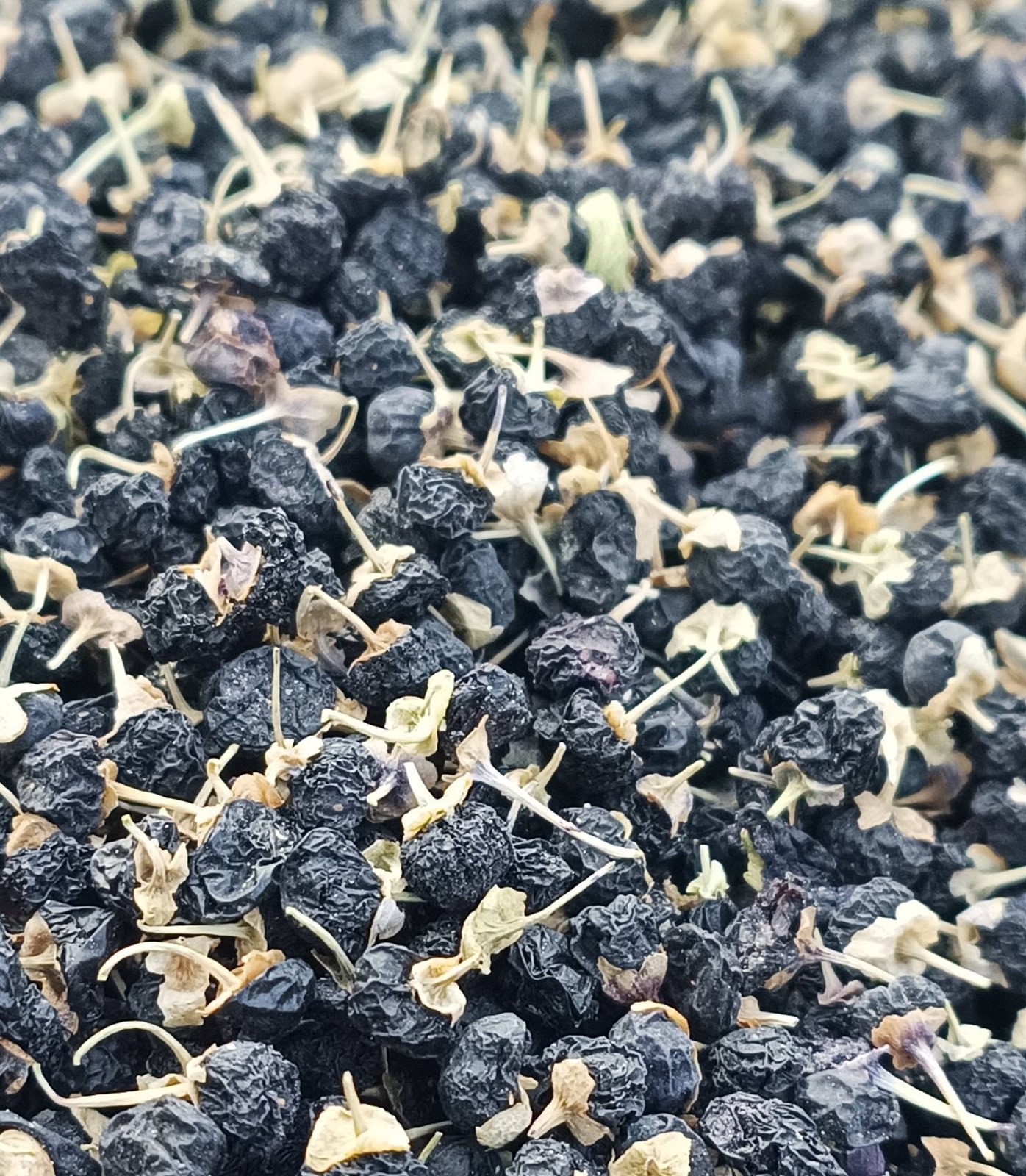
Dried berries, each with its pale stalk and papery calyxClose up: wrinkled, purple-black skins
From shrub to cup
Late summer
Picking
The berries are picked by hand once they turn purple-black. The spines make it slow, careful work.
Within days
Drying
Fresh berries keep for only about three days. They are dried in the sun, in warm air or by freeze-drying.
Drying and colour
Gentle is better
In studies, freeze-dried berries kept the most of their purple pigments; berries dried in hot air or in the sun kept much less.
Sorting
Graded by size
A draft Qinghai standard sorts dried berries on 5, 6 and 7 mm sieves. Size sets the grade: larger berries fetch a higher price.
Black goji from Green Botanica
The science of colour
Why the tea turns violet
The colour of black goji comes from anthocyanins, the family of pigments that colours blueberries, red cabbage and red grapes. In black goji one pigment stands out: petanin, a petunidin anthocyanin with an extra side chain of coumaric acid. Like other anthocyanins, it changes colour with acidity, so one cup can move from pink to violet to blue.
Acidic
Pink to red
A squeeze of lemon
Mildly acidic
Almost clear
The colour fades
Neutral
Violet
Plain water
Mildly alkaline
Blue
Hard tap water, a pinch of baking soda
Strongly alkaline
Green-blue
Fades quickly; laboratory only
What makes the colour hold, and fade
A protective side chain
Petanin carries a coumaric acid side chain. In laboratory tests, this “acylation” made the colour stronger and longer-lasting.
Acid turns it pink
Lemon turns the cup pink to red; baking soda pushes it towards blue. In the lab, acidic pink solutions kept their colour for weeks in the fridge.
Heat and time fade it
Very hot water and long steeping turn the cup dull and brownish. During storage, warmth slowly fades the pigments in the berries too.
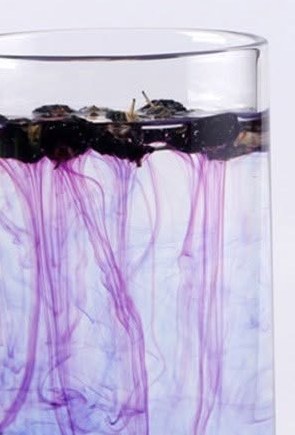
Colour spreading from the berries
Tea & kitchen
Brewing and enjoying black goji
Mild
Soft and gentle
Lightly sweet
A hint of dried fruit
Berry-like
Think dried cranberry
Violet-blue
Pink with lemon
How to brew
Measure. 10–15 berries for a 250 ml cup. More berries give a deeper colour.
Steep. Use warm, not boiling, water, about 50–60 °C, and steep for 3–5 minutes, until violet-blue. Hotter water or longer steeping turns it dull and brownish.
Finish. Drink it plain or with a little honey; lemon turns it pink. Steep the berries once more, then eat them if you like.
Ways to use it
Warm tea in a clear glass
Iced, with lemon and a little honey
Pink lemonade (recipe below)
Sparkling water with a slice of lemon
A splash of colour in smoothies
Cold water in the fridge: the colour comes slowly
Black goji tea in a glass cup
Black goji pink lemonade
After Two Plaid Aprons; makes about 1 litre
1 tbsp black goji (about 50 berries)
1 litre water at 50–60 °C
1 lemon, thinly sliced
100–150 g sugar, to taste
60 ml water for the syrup
Ice, to serve
Simmer the lemon slices with the sugar and 60 ml water until the pith turns translucent, then cool. Steep the berries for 3–5 minutes, strain and chill. Put a spoonful of lemon syrup and a slice of lemon in each glass, add ice and pour over the violet tea: it turns pink as you stir.
More ideas
— simple home ideas, not traditional recipes
Sparkling spritz
Pour cooled black goji tea over ice and top up with sparkling water and a slice of lime.
Pink breakfast
Stir a little cooled tea into yoghurt or overnight oats: their natural acidity turns it pink.
Violet and blue
Serve black goji tea beside butterfly pea tea and add lemon to both: one turns pink, the other violet.
Beyond flavour
Tradition and research
Black goji is first of all a tea and a colour. It also has a long place in traditional medicine, and its pigments interest researchers.
What researchers are exploring now
We found no clinical trials of black goji in people. Two recent laboratory studies show where research is heading:
Researchers added black goji anthocyanins to stool samples from healthy volunteers and from people after a stroke, and let them ferment in the laboratory. The anthocyanins increased the variety of gut bacteria, including Bifidobacterium, and the short-chain fatty acids they produce. A test-tube study with human samples, not a trial in people.
International Journal of Molecular Sciences · 2025
In rat heart cells aged in the laboratory and in zebrafish exposed to oxidative stress, black goji anthocyanins raised survival and the body’s own antioxidant enzymes, and lowered markers of cell ageing. Concentrated extracts in cells and fish; it does not show effects in people.
Educational product information. Not medical advice. If you are pregnant, breastfeeding or taking medication, consult your doctor before using a new botanical product.